Peaka is a powerful data management backend that enables seamless integration and efficient data operations. Users can create projects to organize their data and establish catalogs for easier access.
Users can run queries to retrieve specific information or perform operations. Peaka's caching capabilities enhance performance by storing frequently accessed data, reducing retrieval times. This ensures efficient data operations, allowing users to focus on insights rather than waiting for processes to complete. Overall, Peaka empowers users to manage their data effectively in backend.
Key Features
- Seamless Integration: Easily connect with various third-party services to enhance your data management capabilities.
- Efficient Data Operations: Utilize APIs for creating projects, catalogs, and executing queries to streamline your data workflows.
- Advanced Caching: Optimize performance with a versatile caching API that supports creating, updating, and managing cache states.
- Query Execution: Execute queries to retrieve specific information or perform operations.
Step-by-Step Implementation
1. Creating Partner API Key
-
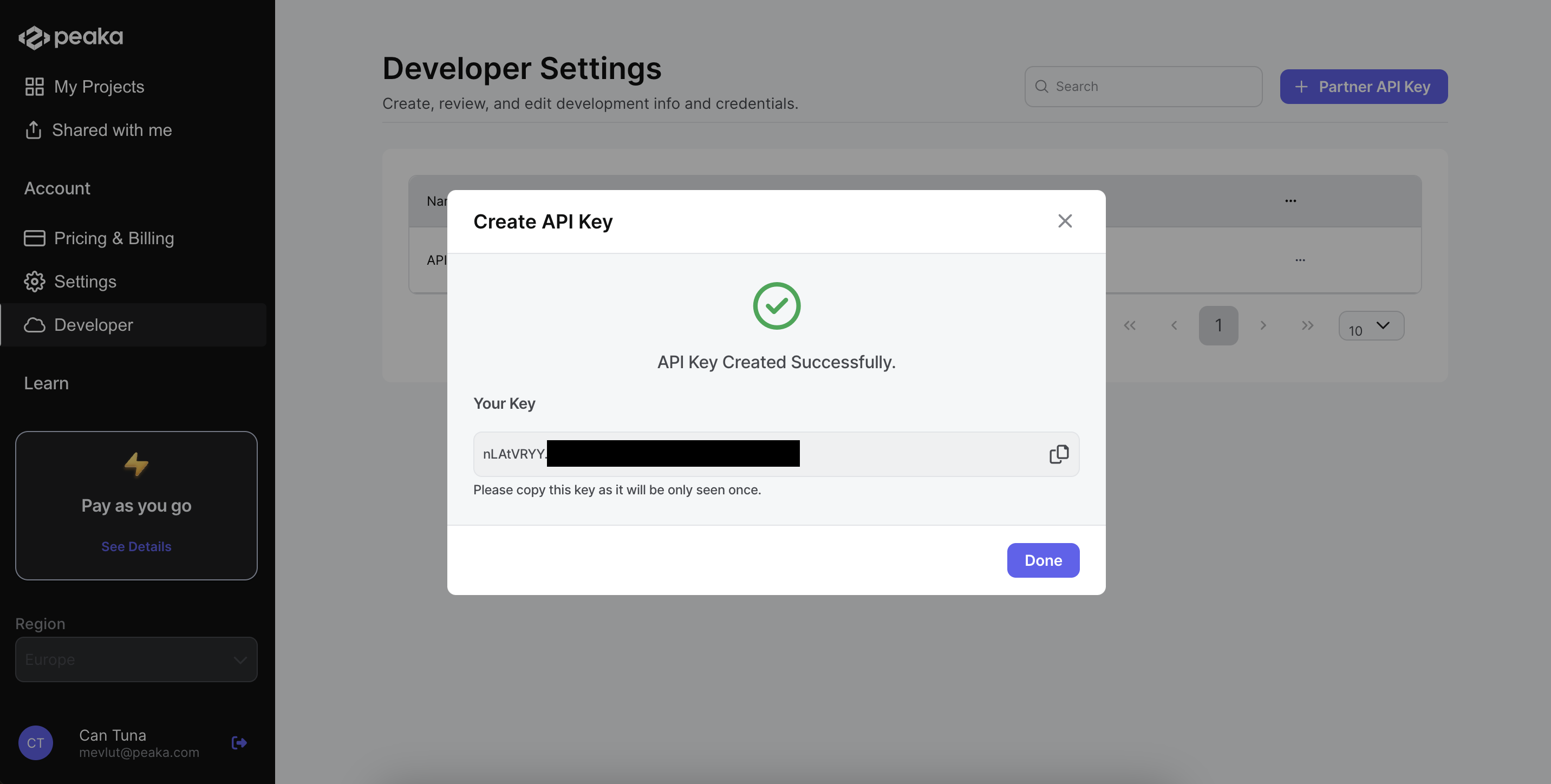
Prior to initiating the creation of a project, it is essential to generate a Partner API key. This key serves as a crucial authentication mechanism for your project creation requests to the Peaka API, ensuring secure and authorized access.
-
Navigate to the Developer section.
-
Click on the Partner API Key button to open a dialog box.
-
Fill in the form by entering your desired API Key Name.
-
Click on the Create button.
-
You can copy the API key from the dialog box.
For detailed guidance, please refer to the documentation on how to create a partner API key.
2. Creating a Project
-
Now you have your partner API key, and you need to create a project that will act as a centralized repository for effectively storing and caching your data.
-
Create your project by using below API.
For detailed guidance, please refer to the documentation on how to create a project.
curl --request POST \
    --url https://partner.peaka.studio/api/v1/organizations/{organizationId}/workspaces/{workspaceId}/projects \
    --header 'Authorization: Bearer <token>' \
    --header 'Content-Type: application/json' \
    --data '{
        "name": "Sample Project Name"
    }'
const url = 'https://partner.peaka.studio/api/v1/organizations/{organizationId}/workspaces/{workspaceId}/projects';
const options = {
method: 'POST',
headers: {Authorization: 'Bearer <token>', 'Content-Type': 'application/json'},
body: '{"name":"Sample Project Name"}'
};
try {
const response = await fetch(url, options);
const data = await response.json();
console.log(data);
} catch (error) {
console.error(error);
}import requests
url = "https://partner.peaka.studio/api/v1/organizations/{organizationId}/workspaces/{workspaceId}/projects"
payload = { "name": "Sample Project Name" }
headers = {
"Authorization": "Bearer <token>",
"Content-Type": "application/json"
}
response = requests.post(url, json=payload, headers=headers)
print(response.json())$curl = curl_init();
curl_setopt_array($curl, [
CURLOPT_URL => "https://partner.peaka.studio/api/v1/organizations/{organizationId}/workspaces/{workspaceId}/projects",
CURLOPT_RETURNTRANSFER => true,
CURLOPT_ENCODING => "",
CURLOPT_MAXREDIRS => 10,
CURLOPT_TIMEOUT => 30,
CURLOPT_HTTP_VERSION => CURL_HTTP_VERSION_1_1,
CURLOPT_CUSTOMREQUEST => "POST",
CURLOPT_POSTFIELDS => json_encode([
'name' => 'Sample Project Name'
]),
CURLOPT_HTTPHEADER => [
"Authorization: Bearer <token>",
"Content-Type: application/json"
],
]);
$response = curl_exec($curl);
$err = curl_error($curl);
curl_close($curl);
if ($err) {
echo "cURL Error #:" . $err;
} else {
echo $response;
}package main
import (
"fmt"
"strings"
"net/http"
"io"
)
func main() {
url := "https://partner.peaka.studio/api/v1/organizations/{organizationId}/workspaces/{workspaceId}/projects"
payload := strings.NewReader("{\n \"name\": \"Sample Project Name\"\n}")
req, _ := http.NewRequest("POST", url, payload)
req.Header.Add("Authorization", "Bearer <token>")
req.Header.Add("Content-Type", "application/json")
res, _ := http.DefaultClient.Do(req)
defer res.Body.Close()
body, _ := io.ReadAll(res.Body)
fmt.Println(res)
fmt.Println(string(body))
}HttpResponse<String> response = Unirest.post("https://partner.peaka.studio/api/v1/organizations/{organizationId}/workspaces/{workspaceId}/projects")
.header("Authorization", "Bearer <token>")
.header("Content-Type", "application/json")
.body("{\n \"name\": \"Sample Project Name\"\n}")
.asString();{
"id": "URNg0GIj",
"name": "Sample Project Name",
"description": "Non accusantium ducimus accusantium. Laborum eum accusamus sit sit hic eaque doloremque. Occaecati blanditiis facere consequuntur consectetur culpa reiciendis hic tempore dolorem. Saepe impedit nam necessitatibus maxime numquam voluptatum cum. Adipisci mollitia blanditiis sint inventore ex commodi occaecati ipsam quas.",
"domain": "sampleprojectname-cdcn",
"webhookBaseUrl": "https://sampleprojectname-cdcn--test.api.peaka.host",
"createdAt": "2024-09-10T10:11:02.385253956Z"
}3. Create a API Key
-
Now that you have created your project, you need to create a API key for your project.
-
You will use the API key to authenticate your requests to the Peaka API.
For detailed guidance, please refer to the documentation on how to create a project API key.
curl --request POST \
    --url https://partner.peaka.studio/api/v1/projects/{projectId}/apiKeys \
    --header 'Content-Type: application/json' \
    --data '{
    "name": "test"
}'
const options = {
method: 'POST',
headers: {'Content-Type': 'application/json'},
body: '{"name":"test"}'
};
fetch('https://partner.peaka.studio/api/v1/projects/{projectId}/apiKeys', options)
.then(response => response.json())
.then(response => console.log(response))
.catch(err => console.error(err));import requests
url = "https://partner.peaka.studio/api/v1/projects/{projectId}/apiKeys"
payload = {"name": "test"}
headers = {"Content-Type": "application/json"}
response = requests.request("POST", url, json=payload, headers=headers)
print(response.text)<?php
$curl = curl_init();
curl_setopt_array($curl, [
CURLOPT_URL => "https://partner.peaka.studio/api/v1/projects/{projectId}/apiKeys",
CURLOPT_RETURNTRANSFER => true,
CURLOPT_ENCODING => "",
CURLOPT_MAXREDIRS => 10,
CURLOPT_TIMEOUT => 30,
CURLOPT_HTTP_VERSION => CURL_HTTP_VERSION_1_1,
CURLOPT_CUSTOMREQUEST => "POST",
CURLOPT_POSTFIELDS => "{\n \"name\": \"test\"\n}",
CURLOPT_HTTPHEADER => [
"Content-Type: application/json"
],
]);
$response = curl_exec($curl);
$err = curl_error($curl);
curl_close($curl);
if ($err) {
echo "cURL Error #:" . $err;
} else {
echo $response;
}package main
import (
"fmt"
"strings"
"net/http"
"io/ioutil"
)
func main() {
url := "https://partner.peaka.studio/api/v1/projects/{projectId}/apiKeys"
payload := strings.NewReader("{\n \"name\": \"test\"\n}")
req, _ := http.NewRequest("POST", url, payload)
req.Header.Add("Content-Type", "application/json")
res, _ := http.DefaultClient.Do(req)
defer res.Body.Close()
body, _ := ioutil.ReadAll(res.Body)
fmt.Println(res)
fmt.Println(string(body))
}HttpResponse<String> response = Unirest.post("https://partner.peaka.studio/api/v1/projects/{projectId}/apiKeys")
.header("Content-Type", "application/json")
.body("{\n \"name\": \"test\"\n}")
.asString();{
"name": "test",
"apiKey": "TtgGcQFq.s3fzROFoop8uHG4pS2LYhoqn1rLb6oW6",
"apiKeyId": "21fd1a8d-88d5-4295-b792-5b2113138057"
}4. Creating a Catalog
-
You have successfully created your project and obtained your API key.
-
The next step is to create a catalog, which will serve as a structured collection of data sourced from a specific origin.
-
To view all available catalogs, you can utilize the API. See the documentation on how to get a catalog list for further instructions.
For detailed guidance, please refer to the documentation on how to create a catalog .
curl --request POST \
    --url https://partner.peaka.studio/api/v1/data/projects/{projectId}/catalogs \
    --header 'Content-Type: application/json' \
    --data '{
    "name": "exampleAirtableCatalog",
    "catalogType": "airtable",
    "connectionId": "8db17e23-29de-4dab-8886-af9717e0e742"
}'
const options = {
method: 'POST',
headers: {'Content-Type': 'application/json'},
body: '{"name":"exampleAirtableCatalog","catalogType":"airtable","connectionId":"8db17e23-29de-4dab-8886-af9717e0e742"}'
};
fetch('https://partner.peaka.studio/api/v1/data/projects/{projectId}/catalogs', options)
.then(response => response.json())
.then(response => console.log(response))
.catch(err => console.error(err));import requests
url = "https://partner.peaka.studio/api/v1/data/projects/{projectId}/catalogs"
payload = {
"name": "exampleAirtableCatalog",
"catalogType": "airtable",
"connectionId": "8db17e23-29de-4dab-8886-af9717e0e742"
}
headers = {"Content-Type": "application/json"}
response = requests.request("POST", url, json=payload, headers=headers)<?php
$curl = curl_init();
curl_setopt_array($curl, [
CURLOPT_URL => "https://partner.peaka.studio/api/v1/data/projects/{projectId}/catalogs",
CURLOPT_RETURNTRANSFER => true,
CURLOPT_ENCODING => "",
CURLOPT_MAXREDIRS => 10,
CURLOPT_TIMEOUT => 30,
CURLOPT_HTTP_VERSION => CURL_HTTP_VERSION_1_1,
CURLOPT_CUSTOMREQUEST => "POST",
CURLOPT_POSTFIELDS => "{\n \"name\": \"exampleAirtableCatalog\",\n \"catalogType\": \"airtable\",\n \"connectionId\": \"8db17e23-29de-4dab-8886-af9717e0e742\"\n}",
CURLOPT_HTTPHEADER => [
"Content-Type: application/json"
],
]);
$response = curl_exec($curl);
$err = curl_error($curl);
curl_close($curl);
if ($err) {
echo "cURL Error #:" . $err;
} else {
echo $response;
}package main
import (
"fmt"
"strings"
"net/http"
"io/ioutil"
)
func main() {
url := "https://partner.peaka.studio/api/v1/data/projects/{projectId}/catalogs"
payload := strings.NewReader("{\n \"name\": \"exampleAirtableCatalog\",\n \"catalogType\": \"airtable\",\n \"connectionId\": \"8db17e23-29de-4dab-8886-af9717e0e742\"\n}")
req, _ := http.NewRequest("POST", url, payload)
req.Header.Add("Content-Type", "application/json")
res, _ := http.DefaultClient.Do(req)
defer res.Body.Close()
body, _ := ioutil.ReadAll(res.Body)
fmt.Println(res)
fmt.Println(string(body))
}HttpResponse<String> response = Unirest.post("https://partner.peaka.studio/api/v1/data/projects/{projectId}/catalogs")
.header("Content-Type", "application/json")
.body("{\n \"name\": \"exampleAirtableCatalog\",\n \"catalogType\": \"airtable\",\n \"connectionId\": \"8db17e23-29de-4dab-8886-af9717e0e742\"\n}")
.asString();{
"id": "626654862255325504",
"name": "exampleairtablecatalog",
"displayName": "exampleAirtableCatalog",
"catalogType": "airtable",
"connectionId": "8db17e23-29de-4dab-8886-af9717e0e742"
}5. Cache Your Catalog
- In this step, we will cache your catalog. This allows you to store frequently accessed data in a temporary storage area, which significantly enhances data retrieval speeds.
For detailed guidance, please refer to the documentation on how to cache a catalog.
curl --request POST \
    --url https://partner.peaka.studio/api/v1/data/projects/{projectId}/cache \
    --header 'Content-Type: application/json' \
    --data '{
    "catalogId": "627249916703408649",
    "schemaName": "payment",
    "tableName": "customers"
}'
const options = {
method: 'POST',
headers: {'Content-Type': 'application/json'},
body: '{"catalogId":"627249916703408649","schemaName":"payment","tableName":"customers"}'
};
fetch('https://partner.peaka.studio/api/v1/data/projects/{projectId}/cache', options)
.then(response => response.json())
.then(response => console.log(response))
.catch(err => console.error(err));import requests
url = "https://partner.peaka.studio/api/v1/data/projects/{projectId}/cache"
payload = {
"catalogId": "627249916703408649",
"schemaName": "payment",
"tableName": "customers"
}
headers = {"Content-Type": "application/json"}
response = requests.request("POST", url, json=payload, headers=headers)
print(response.text)<?php
$curl = curl_init();
curl_setopt_array($curl, [
CURLOPT_URL => "https://partner.peaka.studio/api/v1/data/projects/{projectId}/cache",
CURLOPT_RETURNTRANSFER => true,
CURLOPT_ENCODING => "",
CURLOPT_MAXREDIRS => 10,
CURLOPT_TIMEOUT => 30,
CURLOPT_HTTP_VERSION => CURL_HTTP_VERSION_1_1,
CURLOPT_CUSTOMREQUEST => "POST",
CURLOPT_POSTFIELDS => "{\n \"catalogId\": \"627249916703408649\",\n \"schemaName\": \"payment\",\n \"tableName\": \"customers\"\n}",
CURLOPT_HTTPHEADER => [
"Content-Type: application/json"
],
]);
$response = curl_exec($curl);
$err = curl_error($curl);
curl_close($curl);
if ($err) {
echo "cURL Error #:" . $err;
} else {
echo $response;
}package main
import (
"fmt"
"strings"
"net/http"
"io/ioutil"
)
func main() {
url := "https://partner.peaka.studio/api/v1/data/projects/{projectId}/cache"
payload := strings.NewReader("{\n \"catalogId\": \"627249916703408649\",\n \"schemaName\": \"payment\",\n \"tableName\": \"customers\"\n}")
req, _ := http.NewRequest("POST", url, payload)
req.Header.Add("Content-Type", "application/json")
res, _ := http.DefaultClient.Do(req)
defer res.Body.Close()
body, _ := ioutil.ReadAll(res.Body)
fmt.Println(res)
fmt.Println(string(body))
}HttpResponse<String> response = Unirest.post("https://partner.peaka.studio/api/v1/data/projects/{projectId}/cache")
.header("Content-Type", "application/json")
.body("{\n \"catalogId\": \"627249916703408649\",\n \"schemaName\": \"payment\",\n \"tableName\": \"customers\"\n}")
.asString();{
"id": "<string>",
"appId": "<string>",
"catalogId": "<string>",
"schemaName": "<string>",
"tableName": "<string>",
"incrementalCacheSchedule": {
"type": "<string>",
"expression": "<string>"
},
"fullRefreshCacheSchedule": {
"type": "<string>",
"expression": "<string>"
}
}Enabling Auto Update (Scheduling Refreshes)
The request above creates a cache without auto update — the cache is populated once and never refreshed automatically. To keep the cache in sync with the source, enable auto update by including a schedule in your request.
A cache has two independent schedules, both defined by the same Schedule object:
incrementalCacheSchedule: How often Peaka pulls only the new or changed rows since the last run. Faster and cheaper — use this for frequent updates.fullRefreshCacheSchedule: How often Peaka rebuilds the entire cache from scratch. Heavier — use this less frequently to guarantee the cache fully matches the source.
Each schedule is an object with two fields:
| Field | Description |
|---|---|
type | BASIC to enable the schedule, or NONE to disable it. When NONE, expression is ignored. |
expression | The refresh interval as an ISO-8601 duration (only used when type is BASIC). |
The expression is an ISO-8601 duration, not a cron expression or a plain
string like "15 minutes". A malformed expression is the most common cause of
a schedule that silently never runs.
The following table maps each UI Update Frequency option to its equivalent ISO-8601 expression:
| Update Frequency | expression |
|---|---|
| Every 15 minutes | PT15M |
| Every 30 minutes | PT30M |
| Every 1 hour | PT1H |
| Every 2 hours | PT2H |
| Every 6 hours | PT6H |
| Every day | P1D |
| Every week | P7D |
The example below creates a cache that runs an incremental update every hour and a full refresh every week:
curl --request POST \
    --url https://partner.peaka.studio/api/v1/data/projects/{projectId}/cache \
    --header 'Content-Type: application/json' \
    --data '{
    "catalogId": "627249916703408649",
    "schemaName": "payment",
    "tableName": "customers",
    "incrementalCacheSchedule": {
        "type": "BASIC",
        "expression": "PT1H"
    },
    "fullRefreshCacheSchedule": {
        "type": "BASIC",
        "expression": "P7D"
    }
}'
const options = {
method: 'POST',
headers: {'Content-Type': 'application/json'},
body: JSON.stringify({
catalogId: "627249916703408649",
schemaName: "payment",
tableName: "customers",
incrementalCacheSchedule: { type: "BASIC", expression: "PT1H" },
fullRefreshCacheSchedule: { type: "BASIC", expression: "P7D" }
})
};
fetch('https://partner.peaka.studio/api/v1/data/projects/{projectId}/cache', options)
.then(response => response.json())
.then(response => console.log(response))
.catch(err => console.error(err));import requests
url = "https://partner.peaka.studio/api/v1/data/projects/{projectId}/cache"
payload = {
"catalogId": "627249916703408649",
"schemaName": "payment",
"tableName": "customers",
"incrementalCacheSchedule": {"type": "BASIC", "expression": "PT1H"},
"fullRefreshCacheSchedule": {"type": "BASIC", "expression": "P7D"}
}
headers = {"Content-Type": "application/json"}
response = requests.request("POST", url, json=payload, headers=headers)
print(response.text)To turn auto update off, either omit the schedule fields entirely or set their type to NONE:
{
    "catalogId": "627249916703408649",
    "schemaName": "payment",
    "tableName": "customers",
    "incrementalCacheSchedule": { "type": "NONE" },
    "fullRefreshCacheSchedule": { "type": "NONE" }
}Note: You can update the schedules of an existing cache at any time with the update cache settings endpoint, or trigger a one-off refresh with the incremental or full refresh endpoints.
6. Write Your Query
-
Now you have created your project, API key, and catalog. Also cached your catalog.
-
You are now ready to create queries that allow you to extract and refine data from your catalog based on your requirements.
For detailed guidance, please refer to the documentation on how to create a query.
curl --request POST \
    --url https://partner.peaka.studio/api/v1/data/projects/{projectId}/queries \
    --header 'Content-Type: application/json' \
    --data '{
    "displayName": "sampleQuery",
    "inputQuery": "SELECT * from \"mycatalog\".payment.customers"
}'
const options = {
method: 'POST',
headers: {'Content-Type': 'application/json'},
body: '{"displayName":"sampleQuery","inputQuery":"SELECT * from \"mycatalog\".payment.customers"}'
};
fetch('https://partner.peaka.studio/api/v1/data/projects/{projectId}/queries', options)
.then(response => response.json())
.then(response => console.log(response))
.catch(err => console.error(err));import requests
url = "https://partner.peaka.studio/api/v1/data/projects/{projectId}/queries"
payload = {
"displayName": "sampleQuery",
"inputQuery": "SELECT * from \"mycatalog\".payment.customers"
}
headers = {"Content-Type": "application/json"}
response = requests.request("POST", url, json=payload, headers=headers)
print(response.text)<?php
$curl = curl_init();
curl_setopt_array($curl, [
CURLOPT_URL => "https://partner.peaka.studio/api/v1/data/projects/{projectId}/queries",
CURLOPT_RETURNTRANSFER => true,
CURLOPT_ENCODING => "",
CURLOPT_MAXREDIRS => 10,
CURLOPT_TIMEOUT => 30,
CURLOPT_HTTP_VERSION => CURL_HTTP_VERSION_1_1,
CURLOPT_CUSTOMREQUEST => "POST",
CURLOPT_POSTFIELDS => "{\n \"displayName\": \"sampleQuery\",\n \"inputQuery\": \"SELECT * from \\\"mycatalog\\\".payment.customers\"\n}",
CURLOPT_HTTPHEADER => [
"Content-Type: application/json"
],
]);
$response = curl_exec($curl);
$err = curl_error($curl);
curl_close($curl);
if ($err) {
echo "cURL Error #:" . $err;
} else {
echo $response;
}package main
import (
"fmt"
"strings"
"net/http"
"io/ioutil"
)
func main() {
url := "https://partner.peaka.studio/api/v1/data/projects/{projectId}/queries"
payload := strings.NewReader("{\n \"displayName\": \"sampleQuery\",\n \"inputQuery\": \"SELECT * from \\\"mycatalog\\\".payment.customers\"\n}")
req, _ := http.NewRequest("POST", url, payload)
req.Header.Add("Content-Type", "application/json")
res, _ := http.DefaultClient.Do(req)
defer res.Body.Close()
body, _ := ioutil.ReadAll(res.Body)
fmt.Println(res)
fmt.Println(string(body))
}HttpResponse<String> response = Unirest.post("https://partner.peaka.studio/api/v1/data/projects/{projectId}/queries")
.header("Content-Type", "application/json")
.body("{\n \"displayName\": \"sampleQuery\",\n \"inputQuery\": \"SELECT * from \\\"mycatalog\\\".payment.customers\"\n}")
.asString();{
"id": "<string>",
"displayName": "<string>",
"name": "<string>",
"inputQuery": "<string>",
"inputQueryRefId": "<string>",
"queryType": "<string>",
"schedule": {
"expression": "<string>"
}
}7. Run Your Query
-
Last step is to run your query.
-
After running query is completed, you will get the data in response. You can use this data for further processing or analysis as needed.
For detailed guidance, please refer to the documentation on how to run a query.
curl --request POST \
--url https://partner.peaka.studio/api/v1/data/projects/{projectId}/queries/execute \
--header 'Content-Type: application/json' \
--data '{
"from": [
    {
    "catalogName": "peaka",
    "schemaName": "query",
    "tableName": "samplequery"
    }
]
}'
const options = {
method: 'POST',
headers: {'Content-Type': 'application/json'},
body: '{"from":[{"catalogName":"peaka","schemaName":"query","tableName":"samplequery"}]}'
};
fetch('https://partner.peaka.studio/api/v1/data/projects/{projectId}/queries/execute', options)
.then(response => response.json())
.then(response => console.log(response))
.catch(err => console.error(err));import requests
url = "https://partner.peaka.studio/api/v1/data/projects/{projectId}/queries/execute"
payload = {"from": [
{
"catalogName": "peaka",
"schemaName": "query",
"tableName": "samplequery"
}
]}
headers = {"Content-Type": "application/json"}
response = requests.request("POST", url, json=payload, headers=headers)
print(response.text)<?php
$curl = curl_init();
curl_setopt_array($curl, [
CURLOPT_URL => "https://partner.peaka.studio/api/v1/data/projects/{projectId}/queries/execute",
CURLOPT_RETURNTRANSFER => true,
CURLOPT_ENCODING => "",
CURLOPT_MAXREDIRS => 10,
CURLOPT_TIMEOUT => 30,
CURLOPT_HTTP_VERSION => CURL_HTTP_VERSION_1_1,
CURLOPT_CUSTOMREQUEST => "POST",
CURLOPT_POSTFIELDS => "{\n \"from\": [\n {\n \"catalogName\": \"peaka\",\n \"schemaName\": \"query\",\n \"tableName\": \"samplequery\"\n }\n ]\n}",
CURLOPT_HTTPHEADER => [
"Content-Type: application/json"
],
]);
$response = curl_exec($curl);
$err = curl_error($curl);
curl_close($curl);
if ($err) {
echo "cURL Error #:" . $err;
} else {
echo $response;
}package main
import (
"fmt"
"strings"
"net/http"
"io/ioutil"
)
func main() {
url := "https://partner.peaka.studio/api/v1/data/projects/{projectId}/queries/execute"
payload := strings.NewReader("{\n \"from\": [\n {\n \"catalogName\": \"peaka\",\n \"schemaName\": \"query\",\n \"tableName\": \"samplequery\"\n }\n ]\n}")
req, _ := http.NewRequest("POST", url, payload)
req.Header.Add("Content-Type", "application/json")
res, _ := http.DefaultClient.Do(req)
defer res.Body.Close()
body, _ := ioutil.ReadAll(res.Body)
fmt.Println(res)
fmt.Println(string(body))
}HttpResponse<String> response = Unirest.post("https://partner.peaka.studio/api/v1/data/projects/{projectId}/queries/execute")
.header("Content-Type", "application/json")
.body("{\n \"from\": [\n {\n \"catalogName\": \"peaka\",\n \"schemaName\": \"query\",\n \"tableName\": \"samplequery\"\n }\n ]\n}")
.asString();{
"columns": [
{
"catalogId": "2",
"catalogName": "peaka",
"schemaName": "query",
"tableName": "samplequery",
"columnName": "amount"
}
],
"data": [
[
{
"name": "amount",
"displayName": "amount",
"dataType": "bigint",
"value": "75",
"order": 0
}
],
[
{
"name": "amount",
"displayName": "amount",
"dataType": "bigint",
"value": "75",
"order": 0
}
],
[
{
"name": "amount",
"displayName": "amount",
"dataType": "bigint",
"value": "75",
"order": 0
}
]
]
}8. Success
-
You have successfully created your project, generated your API key, established your catalog, cached the catalog, and executed your query.
-
This data is now ready for advanced processing and insightful analysis.
-
You have effectively integrated Peaka as your robust data management backend.