
AI-Ready vs. Traditional Data Infrastructure
Traditional data infrastructure was built for human analysts. Humans are forgiving consumers. They ask colleagues when something is unclear, they know which numbers to trust, and they carry institutional context that no schema ever documented. AI agents cannot do any of that. They act on what the data says, with full confidence, whether it is right or wrong. That difference changes everything about how data infrastructure needs to be designed.
An AI agent cannot ask a follow-up question, infer business intent from a poorly labeled field, or distinguish between a stale snapshot and a live feed. A wrong answer stops being a misread number on a chart and becomes an action taken.
That consequence asymmetry is the defining shift, and most infrastructure decisions in enterprise data were made before it existed. Traditional architecture was optimized for batch processing, periodic analytics, and relational schemas normalized for joins. It worked because the humans consuming it compensated for its gaps. Remove the human from that loop and replace them with an agent executing autonomously, and every assumption the infrastructure was built on collapses at once.
The collapse is already underway
The most visible collapse is latency tolerance. A nightly batch refresh that serves a morning dashboard is already stale for an agent making a real-time decision. But the deeper collapse is interpretive. Institutional memory lived in people, in the analyst who remembered the Q3 re-classification meeting, in the data engineer who knew which pipeline occasionally drops a day. Now that memory needs to live in the data itself. For most enterprises, it simply does not.
The scale of what's coming makes this more urgent, not less. Gartner projects that 40% of enterprise applications will integrate task-specific AI agents by the end of 2026, up from less than 5% in 2025. That trajectory means agent-driven query volume will rapidly overwhelm governance frameworks designed for human-paced access. And the bulk of enterprise data is unstructured, spanning images, audio, documents, and transcripts. Traditional infrastructure treated that as an edge case. For AI agents, it is the primary workload.
The five properties that define AI-ready data
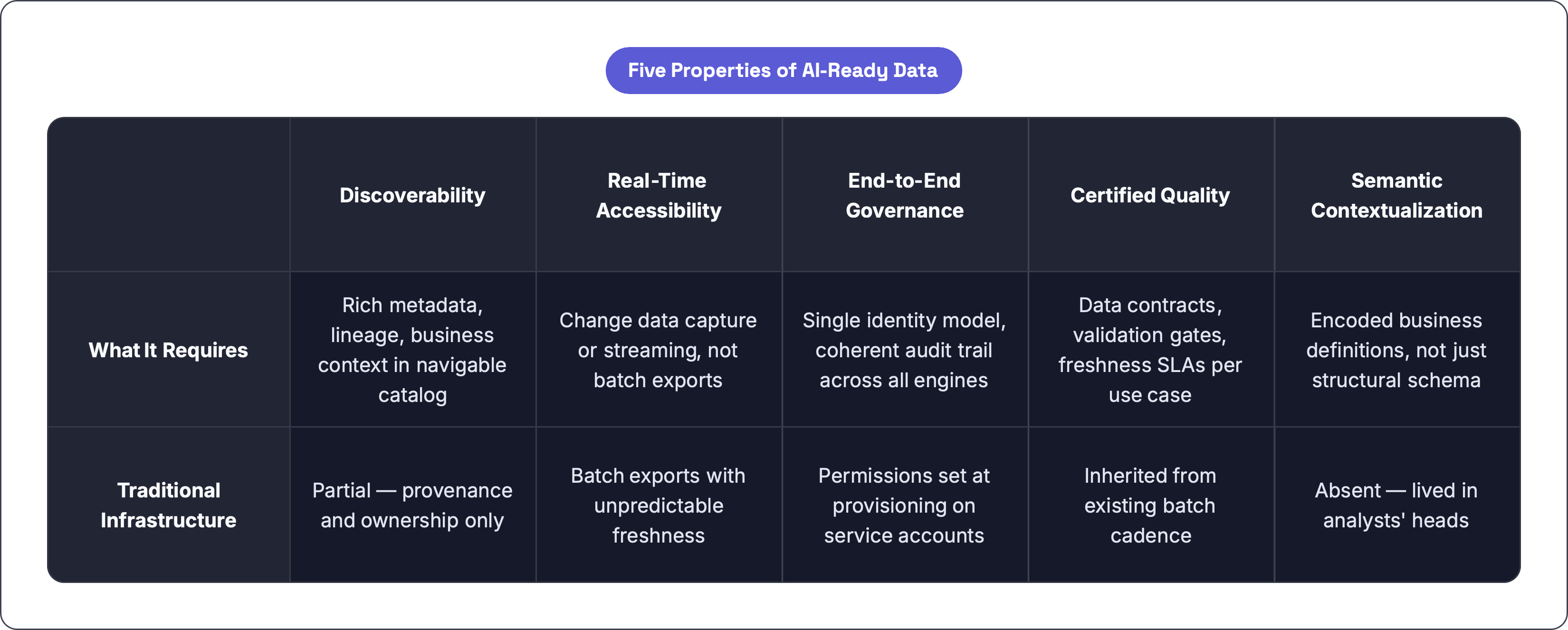
BI-ready and AI-ready are not the same thing. Conflating them is the source of most failed AI pilots, and it happens constantly. AI-ready data requires five properties that should all be upheld at once:
- Discoverability: rich metadata including ownership, lineage, and business context in a catalog an agent can actually navigate.
- Real-time or near-real-time accessibility: change data capture or streaming pipelines, not batch exports with unpredictable freshness.
- End-to-end governance: a single identity model and a coherent audit trail across every engine and every agent traversal.
- Certified quality: data contracts, validation gates, and freshness SLAs designed per use case rather than inherited from whatever the existing batch cadence happens to produce.
- Semantic contextualization: the data must carry an explanation of what it means, not just what it is.
Where traditional infrastructure falls short
Traditional infrastructure typically addresses fragments of the first four and ignores the fifth entirely. Metadata describes provenance and ownership, useful for lineage audits, but it does not explain what a metric means to a query engine. Access controls are assigned at provisioning time on service accounts. Schemas are normalized for joins, not structured for retrieval. The semantic layer was never part of the design because it was never needed; the analyst had it in their head.
The gap isn't a lack of tooling, which exists at every layer already; it's a design failure to recognize that the consumer changed while the infrastructure did not.
The most common architectural mistake being made right now is bolting a vector layer onto a data warehouse without rebuilding the metadata layer underneath it. The demo works, but production doesn't hold up. The agent retrieves something, generates a confident answer, and the answer is wrong in ways that take weeks to diagnose because nobody instrumented the data layer to explain itself. That failure mode traces directly to the absence of those five properties.
The semantic layer advantage
From schema to semantic layer
A schema tells you what data exists. A semantic layer tells you what it means. It encodes business definitions, metric logic, calculation rules, relationships between entities, and the exceptions that apply in specific contexts, all in one governed layer that every consumer queries through.
Traditional infrastructure exposed schemas because that was sufficient. An analyst could read the schema, cross-reference their institutional knowledge, and produce a correct answer. The semantic translation happened inside a human brain, informally, invisibly, non-reproducibly. Nobody documented it because nobody had to.
When an LLM is the analyst, that translation does not happen. The model generates syntactically valid SQL against a raw schema and produces an answer that is wrong in ways that look exactly like right answers. The query runs and the number appears, with confidence indistinguishable from a correct result. The error is invisible until downstream, and by then the damage is done.
The research behind the shift
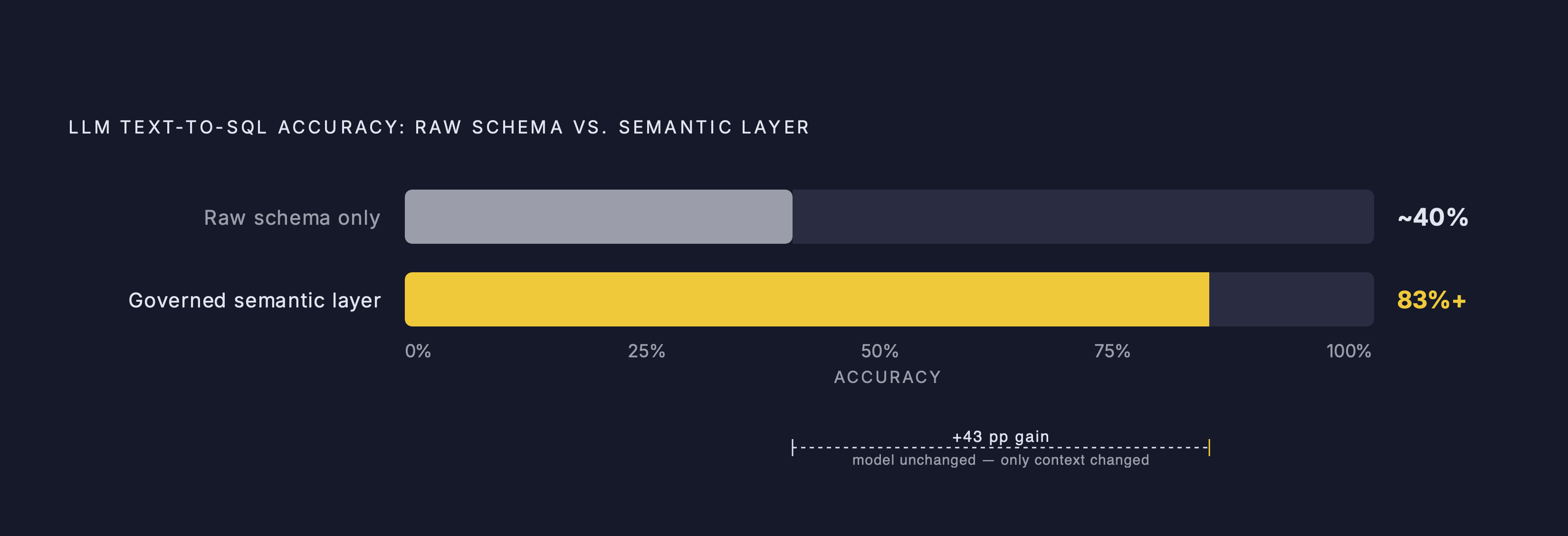
Published research shows LLM analytical accuracy improving from roughly 40% without a semantic layer to over 83% when grounded in governed semantic definitions. A 2026 arXiv benchmark found accuracy gains of 17 to 23 percentage points across multiple frontier models when a semantic-layer document was supplied alongside the raw schema. The model did not change. The context did. Organizations keep treating that finding as a footnote.
Gartner elevated the semantic layer to essential infrastructure in the 2025 Hype Cycle for Business Intelligence and Analytics. GigaOm classified the category as mature for the first time that same year, after years of it occupying an ambiguous middle ground between nice-to-have and architectural requirement. The practitioner community reached this conclusion through experience, not through vendor roadmaps. The organizations that figured it out generally did so after getting burned by the alternative.
Built for consistency and governance
The semantic layer also resolves a consistency problem that process never reliably could. If business logic is defined once in a governed semantic layer, every consumer, BI tools, analysts, AI agents, gets the same definition. Consistency becomes an architectural property rather than a convention enforced by institutional memory that walks out the door when someone leaves.
Combined with emerging protocols like MCP (Model Context Protocol), the semantic layer allows agents to reason over governed definitions rather than make probabilistic inferences about what a column probably means. That distinction matters enormously when the agent is acting rather than just reading. This is the design principle Peaka is built on. It's a semantic catalog where business definitions and access policies live together, exposed to agents through MCP, so what a query means and what it is allowed to touch are never defined in two different places.
Governance for agent-driven queries
Three broken assumptions
Traditional governance was built on three assumptions. It assumed human-paced access, structured data, and permissions set at provisioning time. All three fail under agentic workloads, and they fail in ways that traditional frameworks have no mechanism to address.
Human-paced access meant a governance team could, in principle, review access requests, audit logs, and exception reports because the volume was manageable. Agent-level query volume is not manageable by inspection. The audit trail has to be automated, comprehensive, and machine-readable from the start.
Permissions set at provisioning time on service accounts create a specific problem. A shared service account with broad access cannot be scoped to a single workload without affecting everything else relying on it. When an agent executes a query, the permissions need to reflect the actual end user's identity, evaluated at the moment of the query, not a service account provisioned months earlier. That is a fundamentally different model, and most existing frameworks were not designed for it.
The combination risk
The governance gap that gets underestimated most consistently is sensitivity at the combination level. A field-level sensitivity label tells you that a given column contains PII. It does not tell you that combining three individually non-sensitive columns creates an exposure equivalent to direct identification. Agents traverse data in non-linear ways, joining sources that analysts would never have combined in a single session. Governance frameworks that evaluate sensitivity field by field, at ingestion time, will miss the exposures that actually materialize in production.
Write actions carried out by agents require different risk calibration than reads. An agent that can execute writes, trigger downstream processes, or initiate external API calls creates a risk surface that read-only governance was never designed to constrain. This is where the gap between "we have a governance framework" and "our governance framework covers agentic workloads" becomes consequential rather than theoretical.
Regulatory pressure is rising
IDC's 2026 enterprise AI planning data shows AI data governance became the top AI adoption priority at 45.7% of organizations, overtaking AI business strategy and AI infrastructure. That ranking reflects hard-won understanding. Organizations that moved fast on model deployment and slow on governance are now living with the consequences, and in many cases those consequences are visible enough to inform the decisions of organizations still in early deployment stages.
The EU AI Act entered into force in August 2024 and began phasing in substantive obligations in February 2025. More than half of organizations now identify compliance and regulatory readiness as their primary AI adoption challenge. Regulatory pressure is accelerating what should have been an architectural priority from the beginning.
Why AI initiatives stall
The numbers behind the failures
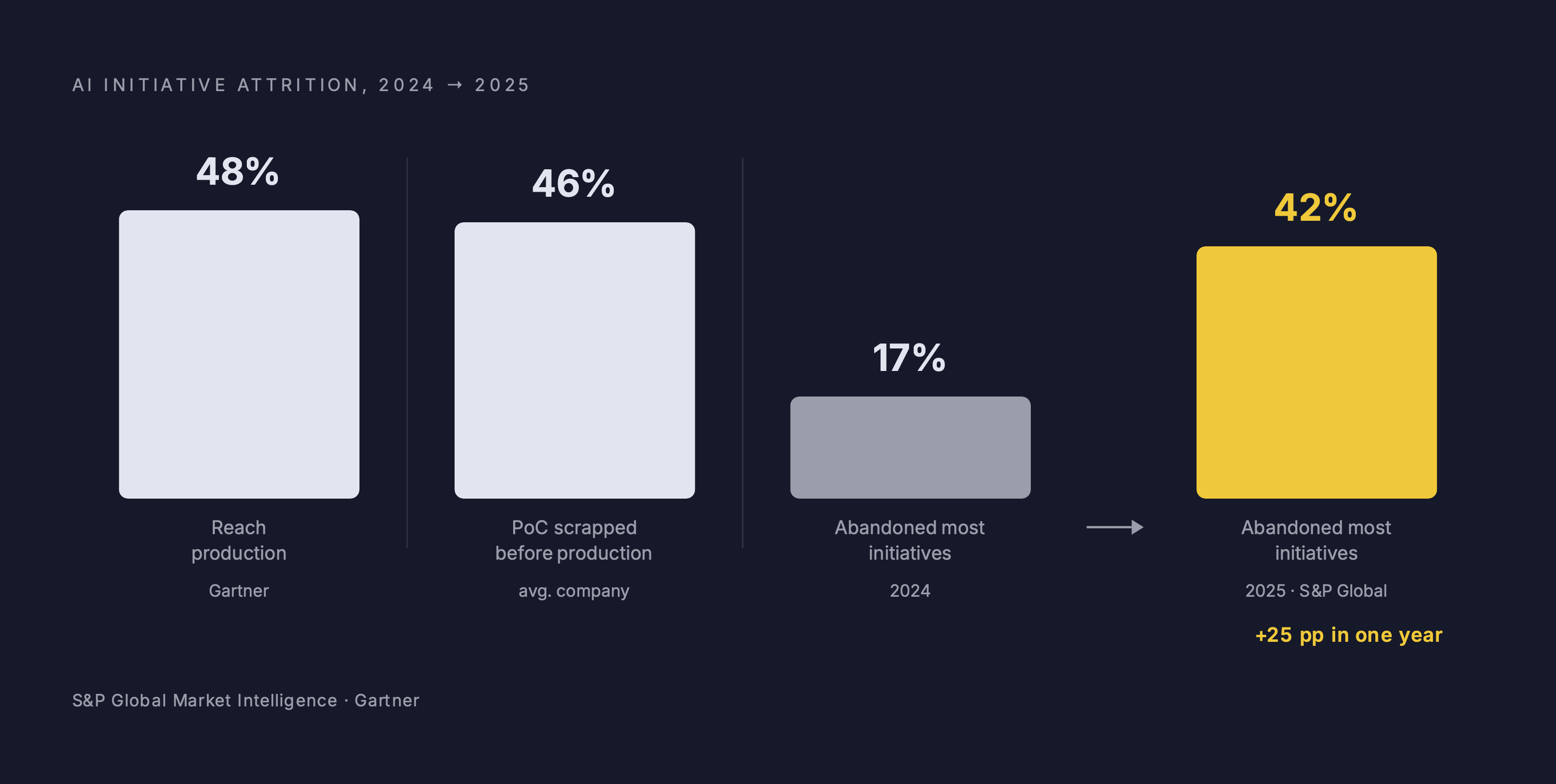
MIT Project NANDA published findings in July 2025 showing that 95% of organizations deploying generative AI saw zero measurable return. S&P Global Market Intelligence found that the share of companies abandoning most AI initiatives jumped from 17% in 2024 to 42% in 2025, with the average company scrapping 46% of proofs of concept before production. Gartner's data shows that only 48% of AI projects reach production, and the median time from prototype to production is eight months.
The common failure pattern
The failure pattern is consistent across organizations and industries, consistent enough to be predictable. A team identifies a compelling use case, selects a capable model, builds a demo against a clean, curated dataset. The demo impresses stakeholders. Then production exposes that the actual enterprise data is ambiguous, stale, ungoverned, inconsistently defined, and structurally incompatible with what an AI agent needs. The project stalls. The prototype gets scrapped. The lesson recorded is "AI doesn't work for us," when the actual lesson is that someone tried to run AI infrastructure on top of analyst infrastructure.
Informatica's 2025 survey of 600 data leaders globally found that 43% cite data quality, completeness, and readiness as the leading obstacle preventing AI pilots from reaching production. A study from Drexel University and Precisely found that 62% of organizations cite lack of data governance as the primary barrier to successful AI initiatives. These numbers describe a sequencing problem. Organizations selected use cases and models before establishing the data foundation those models require.
What high performers do differently
The organizations that consistently produce measurable AI returns made a different call. They built data infrastructure before selecting use cases. McKinsey's 2025 State of AI report found that high performers were nearly three times as likely to have fundamentally redesigned workflows, and that strong data infrastructure was among the practices most consistently associated with meaningful returns. Infrastructure first, use cases second. It sounds obvious in retrospect. Most organizations still have not done it.
Building AI-ready infrastructure
The Peaka approach
For most enterprises, replacing existing warehouses and pipelines outright isn't practical, so the architectural task has to be additive and integrative instead.
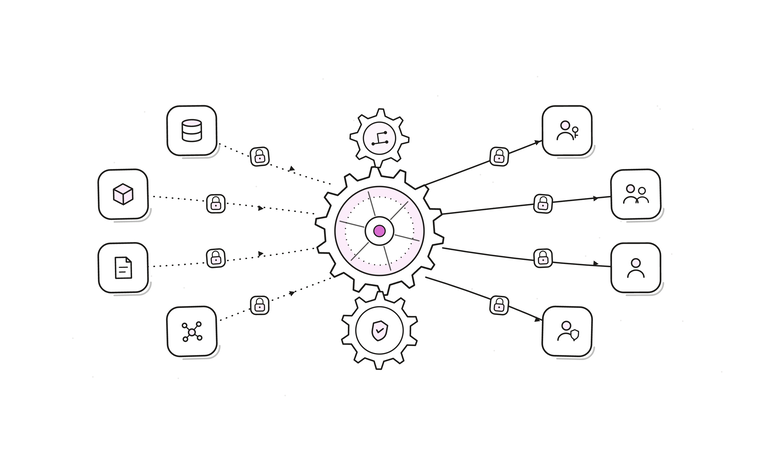
That is the approach Peaka takes. It connects the sources an enterprise already runs, from warehouses like Snowflake and BigQuery to databases and SaaS APIs, and adds the semantic and governance layer above them without moving the data. The semantic layer sits above existing storage and exposes a single interface carrying business definitions and metric logic. Agents query meaning rather than raw schema. The translation that used to happen inside an analyst's head is encoded, versioned, governed, and available to every consumer uniformly, including the ones that cannot improvise.
Governance and data contracts
Governance enforced at the query layer, not patched at the model or prompt layer, means permissions evaluated at runtime under the real user's identity. Every query logged with full lineage capturing identity, intent, and the data traversed. Sensitivity evaluated at the combination level, not field by field. Write actions governed under stricter controls than reads, with explicit rather than implicit constraints.
Data contracts and validation gates encode freshness and quality requirements per use case. A streaming feed informing an agent decision carries different SLA requirements than a nightly batch populating a dashboard. The infrastructure should enforce that distinction explicitly. Convention has never been a reliable mechanism for managing it.
The bottom line
The underlying shift is from infrastructure designed for consumers who fill in what the schema omits, to infrastructure that carries its own context, enforces its own permissions, and logs its own lineage. Because the consumer on the other end cannot do any of those things itself. The organizations resolving that architectural challenge first are the ones accumulating the performance gap that the aggregate statistics already reflect.
If you're assessing where your own stack falls on that spectrum, Peaka's documentation is a practical place to see what an AI-ready layer looks like on top of infrastructure you already have.

 Please
fill out this field
Please
fill out this field
 Thank you! You have been subscribed.