
Data Access Governance: Framework, Risks, and Tools
There's a particular kind of organizational panic that happens when someone asks "who looked at the customer records last Tuesday?" and the room goes quiet. Nobody answers, because nobody actually knows.
Data access governance (DAG) exists to solve that problem. Most organizations find out they need it right after something goes wrong. Maybe you already have.
At its core, DAG is the set of policies, processes, technologies, and accountability structures that control who can access specific data, under what conditions, and what gets logged when they do. It's a subset of data governance, which lives inside the broader universe of data management. Each layer narrows the scope. Data management handles the entire lifecycle; data governance adds standards and accountability; and DAG specifically handles the access-control layer. The goal (“the right people get the right data at the right time”) is simple to say but genuinely hard to pull off.
The distinction that matters most is between knowing who can access something and knowing who did access it, when, and what they did with it afterward. That second part is where organizations consistently underinvest, until a regulator or a breach forces the issue.
Why 2026 looks nothing like 2016
The global data governance market was valued at $3.91 billion in 2024 and is projected to reach $12.66 billion by 2030 (Grand View Research). Organizations don't spend money like that because someone read a persuasive whitepaper. They spend it because something broke.
The threat environment and the regulatory floor were the two things that broke, roughly simultaneously. In 2024, internal actors were the catalyst behind 35% of data breaches, up from 20% the year before (Verizon DBIR, 2024). The common thread is permissions that outlasted their purpose, a failure of the principle of least privilege that eventually became a problem. Eighty-three percent of organizations reported at least one insider incident in the past year (Cybersecurity Insiders, 2024). Most of those incidents were preventable.
Meanwhile, GDPR never went away, the EU AI Act entered into force in August 2024 with substantive requirements applying from August 2026, and finance and healthcare have always operated under demanding sector-specific rules. The audit log that used to be optional is now a compliance artifact someone will ask for during a regulatory review.
Then there's AI. In 2024, 78% of companies were using AI in at least one business function, up from 55% the prior year (McKinsey, 2024). Every AI deployment is also a new data consumer, one that queries constantly, leaves no paper trail on its own, and lacks institutional memory about which tables to trust. Add agents, APIs, and a proliferating stack of dashboards all hitting the same infrastructure, and manual review of who accessed what becomes operationally impossible at any meaningful scale.
What a real framework does
The core challenge is that most organizations don't have a reliable picture of what data they hold, where it lives, who can reach it, or what's happening to it in real time. Permissions compound the problem by drifting quietly over time. Without a structured framework, there's no way to close that gap at scale.
Sensitive data discovery comes first, because you can't govern what you don't know exists. Sensitive data ends up in inconvenient places, such as S3 buckets nobody's audited in two years, SaaS tools the security team forgot were connected, a spreadsheet someone exported in 2019 and emailed around. A data catalog drives discovery and surfaces what's there.
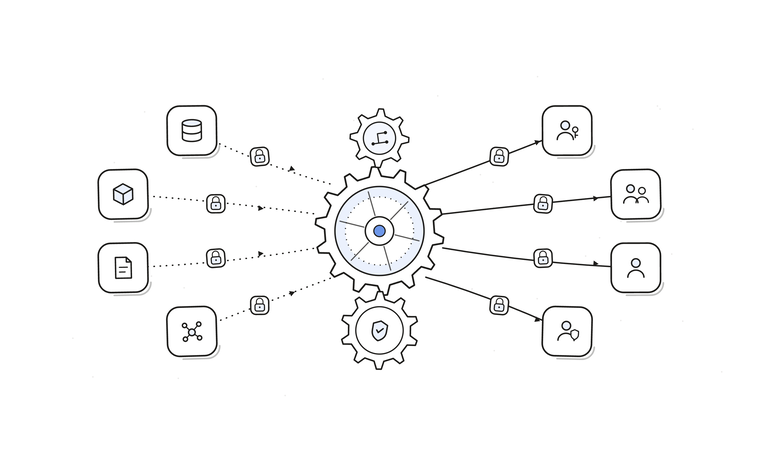
Classification tags data by sensitivity and regulatory category, so policies apply automatically. Access controls, both role-based (RBAC) and attribute-based (ABAC), define what each identity can actually reach. The critical detail is that permissions should be evaluated at query time in a zero-trust model, scoped to the actual end user making the request. Too many systems still inherit permissions from a service account that was provisioned broadly three years ago and never revisited. That's where most teams get caught. It's also exactly what Peaka enforces. When a query runs through Peaka's semantic catalog, permissions are resolved against the real end-user identity at query time, and shared service credentials never enter the equation.
Audit logging is where the accountability layer lives, and it's where most companies have a gap they don't realize exists. Logs that capture only an IP address and a timestamp are functionally uninterpretable when something goes wrong at scale. Useful logs combine identity, intent, data lineage, and business context. That means capturing who ran the query, what business question they were trying to answer, where the underlying data came from, and what happened with the result. Without all four elements together, a high-volume incident becomes a forensic nightmare on a deadline.
Automated remediation closes the loop by quarantining files, blocking access, alerting the security team, and triggering a documented response in real time when something anomalous occurs, rather than the next morning when someone checks their email.
AI makes this harder in specific ways
Only 29% of technology leaders strongly agree that their enterprise data meets the quality, accessibility, and security standards needed to scale generative AI (IBM Institute for Business Value, 2024). That gap is about to get much wider.
An AI agent doesn't operate the way a human analyst does. A human analyst knows which metrics finance actually trusts, which tables became unreliable after a schema change last quarter, and when to ask a clarifying question before running a number up the chain. An agent carries none of that institutional knowledge unless the context is machine-readable and embedded in the infrastructure itself. Stale or partial answers come back looking exactly as confident as correct ones; the agent returns a number either way.
Write actions sit in a different risk category than reads entirely. An agent that can modify or delete data is an actor with real operational consequences, and governance controls for write access need to reflect that distinction explicitly rather than treat it as an edge case.
Model drift is a related problem, particularly in regulated sectors. AI models degrade when fed inconsistent or outdated data, and a governance framework that doesn't track freshness won't catch it until the model is already producing bad outputs at scale.
The semantic layer problem
AI agents resolve ambiguity probabilistically. They infer meaning from column names, schema patterns, and surrounding context. If "Customer" means one thing in the CRM and something else in the billing system, every model that touches both inherits that confusion and becomes a model-drift risk. Prompt engineering can't compensate for a schema that carries no meaning.
A semantic layer sits between raw infrastructure and the things querying it. It translates technical structures into business-meaningful terms, defines metrics once ("Revenue," "Active Customers," "Churn Rate"), and ensures every dashboard, API, and agent query works from the same definitions. The metric in your BI tool matches the metric in the Python notebook, which matches what the AI agent returns. That consistency is built into the structure itself, so it doesn't depend on everyone remembering which version of a calculation is canonical this quarter.
Governance controls belong in the semantic layer, built in from the start. An agent that can reach ungoverned raw tables through a back door makes the rest of the framework decorative. That's the principle Peaka is built around. Its semantic catalog is where both business definitions and access policies live, so there's no gap between what a query means and what it's allowed to touch. If you're evaluating how that works in practice, the documentation is a useful starting point.
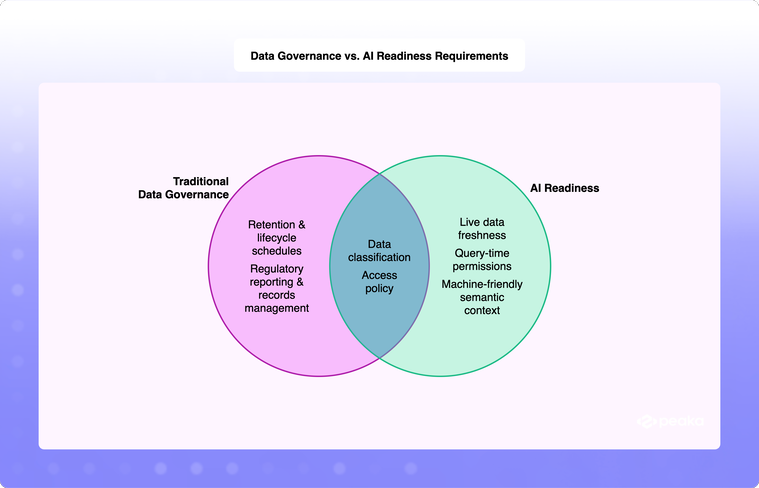
"Clean" is not the same as "AI-ready"
This distinction has real financial consequences. Gartner projects that through 2026, organizations will abandon 60% of AI projects that lack AI-ready data (Gartner, 2025). The pattern is almost always the same: Data was cleaned for human analysts, declared ready, pointed at an AI system, and produced confidently wrong answers.
AI readiness requires that freshness, context, permissions, and lineage be machine-accessible. A weekly snapshot that works perfectly for a Monday morning dashboard is genuinely stale for an agent making a real-time operational decision. Permissions need to match the use case rather than carry over from whatever service account was convenient to reuse. These distinctions produce different outputs, and downstream decisions depend on those outputs being correct.
How organizations are actually handling this
The practical starting point is an honest current-state assessment laying out what's been discovered, what's classified, whether access is enforced at query time, whether there's semantic context, and whether the audit trail is sufficiently complete to be useful during an incident.
The governance layer doesn't require replacing existing infrastructure. Controls can be layered on top of what's already there, whether that's Snowflake, BigQuery, Redshift, or a Databricks lakehouse. Rebuilding from scratch would stall AI programs for years. Data product marketplaces, where producers publish governed and documented data products that consumers can discover and request access to, are becoming the operational mechanism for doing this at scale, borrowing directly from data mesh principles.
Trusted AI requires trusted data. Without governance embedded at the data layer, with semantic context, query-time enforcement, and full audit lineage, AI initiatives tend to follow the same arc which always involves a promising pilot, scaling problem, stall. Getting the governance in place before the stall is considerably cheaper than the alternative.
If you're working through what that looks like for your stack, Peaka's platform is designed to handle exactly this. It unifies data sources, adds the semantic and governance layers, and makes that infrastructure AI-ready without a ground-up rebuild. It's worth a look.
To see how you can introduce data governance into your AI project, book a demo with Peaka.

 Please
fill out this field
Please
fill out this field
 Thank you! You have been subscribed.