
Clean Data vs. AI-Ready Data: What AI Agents Actually Need
Before organizations invested seriously in data quality, decisions were being made on records that were duplicated, formatted inconsistently, missing critical values, or just plain wrong. That cleanup was a direct response to a very real problem.
But clean data made an assumption that's worth calling out. The consumer was a human. Human analysts are forgiving consumers. They have institutional memory. They know "revenue" in the finance model excludes refunds processed in the same billing period. And when a column name is ambiguous, they know to ask in the Slack channel before moving forward.
So clean data got optimized for correctness at rest. The "context", whether in the form of an implied business rule or a field name, lived in people's heads, in Confluence, or in Slack channels. This was an acceptable tradeoff, because humans could go find it.
This worked for a long time. Then, the consumer changed. Today, we'll be discussing the shift we've seen in the data world. We'll talk about how AI agents have brought to light a new type of data, AI-Ready Data, and how it is different from clean data. We'll also talk about how teams need to approach this whole new challenge.
What type of data do AI agents need?
An AI agent is a different kind of consumer. It's stateless at the data layer. Each invocation starts from scratch with no memory of what came before. It generates its own queries from schema names, which means it's making semantic assumptions about what the schema itself provides. Put simply, an AI agent doesn't know what it doesn't know. The failures that follow aren't random. They are a direct result of the given context.
Why won't clean data work for AI agents?
An agent reading a column named column_A won't ask what it means. If the schema has no description attached, the agent infers from context. The produced answer may be syntactically correct, but semantically wrong. From a technical standpoint, a clean value in an under-described column is still an input for an AI agent.
Or think of an agent with access to a data warehouse with the capabilities of answering cross-system questions. If the CRM data, payment data, and product usage data aren't synced in the same ETL (Extract, Transform, Load) window, the answer is partial. By default, we wouldn't know that. The agent doesn't error. It returns an answer. There's no signal that the output is based on an incomplete picture, which is exactly what makes these failures so hard to catch.
How is AI-ready data different?
AI-ready data carries the context an AI agent needs to operate reliably without a human in the loop. It needs to be self-describing, reachable, fresh, and governed at the point of access.
Clean data solved the problem of wrong values. AI-ready data solves the additional problem of missing context. For AI agents, missing context fails just as badly as a wrong value. Often, it fails even more severely, as the output can be misleading.
Where most teams get it wrong
When AI fails on data, the instinct is to reach for more infrastructure. Usually, teams try to compensate through one of two ways.
Vector databases
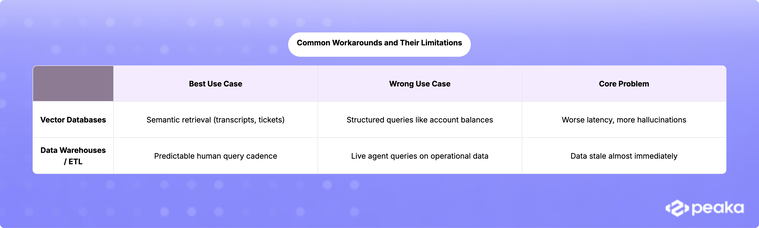
Vector databases are the right tool for semantic retrieval problems. This works for a specific class of use cases, such as call transcripts or support tickets, where meaning is distributed across the text. However, structured questions like "What is the current account balance?" don't fit that model. Forcing it through a vector database gives you worse latency and more hallucinations than a direct structured query would.
Data warehouses
The other common move is to sync more systems and run ETL pipelines more frequently. The problem here is that every system you copy into a data warehouse becomes stale almost immediately. An agent asking about a customer subscription needs data fresh from the source system. A snapshot of it from 20 hours ago has no value. Going down the data warehouse route typically results in excessive engineering overhead without fixing the core issue. You end up with pipelines on top of pipelines and a data team that spends most of its time trying to keep the whole architecture in sync.
So how should teams actually make data AI-ready?
What the data layer needs to do differently for AI agents
Data movement as a prerequisite for data access was a reasonable tradeoff when queries came from humans on a predictable schedule. It breaks when agents query live systems at runtime, against operational sources the warehouse has never seen.
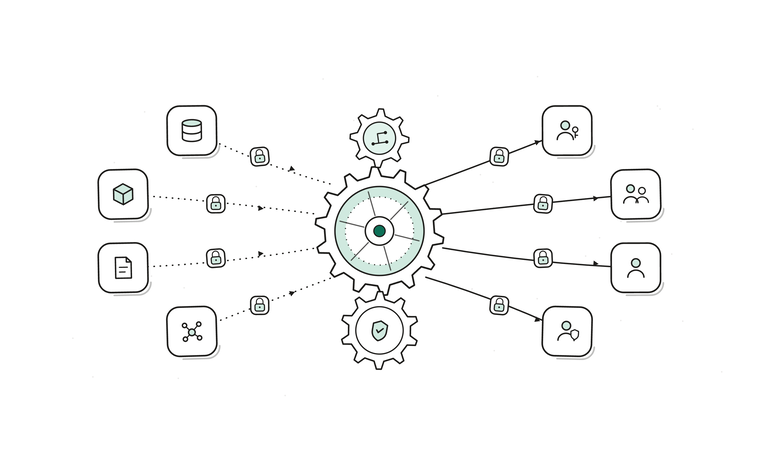
The answer is a layer that federates data across sources, such as warehouses and third-party APIs, at query time. Data that needs to be fresh is delivered live, while data that can tolerate a short lag is intelligently cached.
Additionally, AI agents need data to describe themselves. The failure mode from earlier with the generic column name gets solved by attaching meaningful metadata at the query surface the agent queries through. Table descriptions, column definitions, metric logic, and entity relationships all need to live in the query interface.
Governance is another consideration. When an agent queries a warehouse through a service account with broad read permissions, the warehouse only sees the service account. There is no information about which user the agent is actually acting on behalf of. Therefore, the warehouse can't apply row-level constraints as requested by the user. That is why permissions, scoped to the actual user context, should also live in this data layer. Queries should be routed through each source's existing access control plane with the user's credentials.
Finally, the data layer has to absorb change without breaking. Sources and schemas change. AI agents add new tools. In the old model, every upstream change required a downstream pipeline fix before the warehouse was usable again. A query-time layer like the one we are describing is inherently less brittle because it doesn't require rebuilding a transformation pipeline every time a source evolves. Schema contracts and versioning can be enforced at the query surface, so that breaking changes (e.g., a renamed column) are caught before they reach the agent.
This is all one coherent design with a dynamic layer that sits on top of existing infrastructure, consolidating data and giving AI agents the right conditions to work. That's the architecture Peaka is built around.
Final thoughts
The transition to AI-ready data is more than just adding warehouses or running the existing ETL pipelines faster. The challenge is an architectural one. The standard isn't just clean data anymore. Now, data must have the right context, freshness, governance, and stability present at the query surface.
Meeting that standard is harder. But the teams that do won't just have better AI; they'll have a data layer that keeps up with whatever comes next.
If you’re looking to make your data AI-ready with built-in data governance, book a demo with Peaka.

 Please
fill out this field
Please
fill out this field
 Thank you! You have been subscribed.