
Fine-Grained vs. Coarse-Grained Access Control for AI Agents
Access control exists to answer one question, namely who can do what to which resource. How precisely you answer that question is the interesting part.
Coarse-grained access control answers in broad strokes. You are an admin or you are not. You can read the bucket or you cannot.
Fine-grained access control answers with specificity. You can read objects under s3://reports/2026/q2/ between 9am and 5pm, from a specific VPC, if the object has a specific tag. Or a more realistic example would be a customer service worker only having access to data for the customer they are talking to.
Coarse-grained control makes the role the boundary
Coarse-grained controls trade precision for simplicity by granting access in broad, reusable categories rather than per-request decisions. The most notable example is role-based access control (RBAC) with a small number of available roles. Another example would be Unix file permissions, which has 9 bits representing whether a user can read, write, or execute a specific file.
The appeal for this style is obvious. It makes it easy to give a developer access that can be read in a short list. It is also simple, since every developer can have the same set of permissions, managers can have a different set, and so on. You can write once and apply to all. Reusability is the biggest win you get out of coarse-grained control.
You pay for the reusability with over-provisioning. A one-size-fits-all role is easy to manage, but in reality one size does not fit all. It is sized for the union of everyone's needs, not their intersection. A wide majority of granted permissions go unused, a direct violation of least privilege.
Coarse-grained control works when three assumptions hold. The principals are trusted, their behavior is predictable, and the blast radius of a mistake is tolerable. A human developer with an overly broad role probably will not delete the production database, because humans have context, judgment, and a healthy fear and understanding of what would happen if they do.
Fine-grained control makes the request the boundary
Fine-grained access control shifts the enforcement boundary from the principal to the individual request, evaluating every action against detailed policy in context. Instead of asking whether a principal has permission, the system asks "should this specific action, on this specific resource, in this specific context, be allowed right now?"
Obviously, answering this question takes much more than the 9 bits Unix uses for file permissions. Attribute-based access control (ABAC) evaluates attributes of the principal, the resource, and the environment. For example, policy can be scoped by role, IP address, encryption state, or time of day. Certain databases allow row-level permissions for user access. Scoped API tokens only give a specific user access for a specific point resource.
Fine-grained systems shrink the blast radius of any single compromised or misbehaving principal. If used correctly, they enable true least privilege, where a credential that can do exactly one thing cannot be abused to do a second thing.
The cost is complexity. Policies multiply. Debugging a denied request means tracing evaluation logic across dozens of statements. Someone has to write and maintain all that policy, and policy that is painful to maintain tends to decay into Action: "*" with a TODO comment. Fine-grained control also adds latency, since every request needs a policy decision.
So teams have historically made a pragmatic trade. Coarse roles for humans, who are trusted and slow. Fine-grained scoping for the highest-risk credentials, like anything internet-facing. This trade made sense, until agents came along and broke it.
Agents invalidate the coarse-grained assumptions
An AI agent violates every one of those assumptions. It can't be fully trusted, its behavior isn't predictable, and the blast radius of its mistakes is far from tolerable. Giving AI agents the same permissions humans hold is a grave mistake. While a human moves slowly, an AI agent can make hundreds or thousands of calls in a second. If set off in the wrong direction, an agent could cause irreversible damage. The blast radius of an agent is amplified by speed.
Furthermore, agents can't be fully trusted. An agent's execution path is determined at runtime by a model interpreting natural language. It can be manipulated through prompt injection, a malicious instruction hidden in data the agent reads. When an agent reads untrusted data and holds credentials, the credentials are effectively exposed to whoever wrote the data. This is the confused deputy problem at scale. The agent is the deputy, and everything it reads is a potential instruction.
Giving an agent coarse access is a recipe for disaster. Agents that hold broad permissions require continuous monitoring, and monitoring alone does not prevent damage; it only detects it after the fact. The right model for agents is provisioning that is fine-grained by default, tightly scoped to the task at hand, and resistant to manipulation by the data they read.
This compounds further when teams consider how many distinct sources require permissions. Local files, databases, billing APIs like Stripe, and any other downstream source all carry their own permission requirements. For a simple task, an agent may need permissions across many sources. Making each one fine-grained eats engineering bandwidth.
Federated query layer
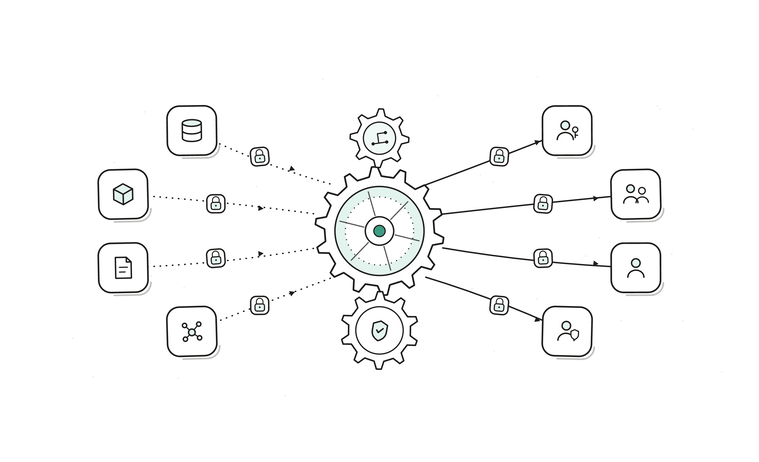
Managing fine-grained permissions across multiple disparate data sources is the primary operational burden of securing AI agents at scale. A federated query layer is the most practical solution. Writing fine-grained policy across every downstream, local files, databases, and billing APIs means duplicating it in multiple dialects and keeping them in sync. That's why merging them into one source and managing it all from there can simplify it.
A federated query layer collapses the problem to one enforcement point. It lets you write it all out in a single source that you manage, and your agents can interact with the data from there. Most services support change data capture (CDC), which allows teams to stream database changes into the query layer without a full re-import.
Platforms like Peaka are built specifically to handle the overhead of fine-grained permissions across many disparate sources. Peaka connects databases, SaaS tools, and APIs into a single queryable layer and lets you define access at the data product level rather than at the source level. Teams overwhelmed by the number of ingress points can try Peaka to see just how much it simplifies their data governance.
Book a demo with Peaka to see how a single federated query layer can turn fine-grained access control from a per-source burden into a one-time setup.

 Please
fill out this field
Please
fill out this field
 Thank you! You have been subscribed.