
How Metadata Enables AI Data Governance at Scale
Prior to general AI adoption and agents being deployed en masse across enterprises, humans were the primary end user for data sources. We manually wrote all queries, scanned tables to perform joins, and knew what a specific column meant in the context of the whole schema. If a financial analyst was referencing a transaction fee column in a financial table, they would likely know whether it referred to a foreign transfer fee, a payment processing fee, or something else entirely. Now that we are hooking up our chatbots and agents to internal databases and asking them to perform analysis or execute a series of actions, we also need to make sure those databases can provide the right context and structure to securely and accurately support agentic use cases.
How agent and human data access differ
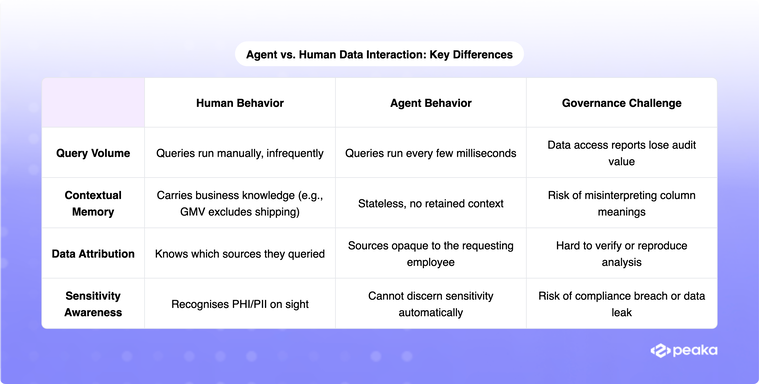
There are a few key differences between agent and human behavior when interacting with data systems, and they shape how we should set up our data to be AI-ready:
- Volume: Agents run queries at multiple times the volume a human would. For any given task, they query to explore the database, understand joins and columns, and execute an action. For any security review that involves a data access report, that report loses much of its value when there are agents performing queries every few milliseconds. The review gets even murkier when those agents aren’t tied to a specific identity. Data sources need a new way to audit who accessed what and when.
- Statelessness: Agents don’t remember the contextual or business knowledge around a piece of data. Sure they can see the GMV column in a table, but they don’t remember that it doesn’t include shipping fees like a data analyst would.
- Attribution: If an employee is asking a chatbot to perform an analysis instead of querying it themselves, they won’t know which sources the data is being pulled from. Knowing the inputs for any answer or analysis ensures it is grounded in accurate and relevant data sources. And on the flip side, preventing a wrong answer from being generated again means knowing what the wrong inputs were.
- Sensitivity: An employee at a healthcare startup may encounter patient intake data and know it’s PHI. Agents cannot automatically perform that discernment. Even with guidelines and guardrails, something could slip through the cracks. And when it comes to sensitive data, even the smallest slip-up could cost an organization compliance certification or enterprise deal.
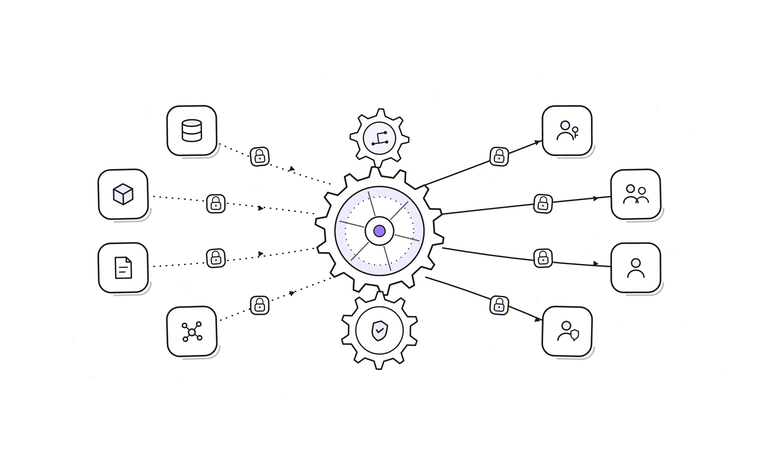
So how can we make sure the AI we deploy across our organizations is equipped with the contextual knowledge needed to query data accurately, securely, and accountably? The answer is a single centralized data control plane with a robust metadata layer. I’m going to walk through what this metadata layer should look like and how a data virtualization platform like Peaka can make that layer a reality for your organization.
Types of metadata and how they support governance controls
Technical metadata
Technical metadata is the set of information that describes the structure of the data source. It includes schema, column, and table names, relations, data types, indices, constraints, and other descriptive context. Anything you need to understand how the database is organized and functions falls into this category, and it is the baseline layer of metadata that every other type depends on.
Business metadata
Business metadata tells you how to make sense of or apply a piece of data in the real world. It’s a complement to technical metadata because, while technical metadata tells you how a piece of data exists, business metadata tells you what it actually means. For example, technical tells you that a specific column is titled q3_cust_rev, is a decimal, and exists in the finance schema. Business tells you it's "Q3 customer revenue, net of refunds, owned by the finance division." Your organization's policies live at this layer, because a rule is far more foolproof when it says "revenue figures are restricted" than when it points at q3_cust_rev by name and breaks the moment a schema changes. Business metadata also gives agents the relevant context that a human analyst would otherwise carry in their head, such as whether a revenue number is net of refunds or whether GMV includes shipping.
Lineage metadata
Lineage metadata provides the track record for any piece of data being queried. It traces the path from the original source through any joins, transformations, or aggregations that were performed, logging everything that happened to generate the final value(s) a query returns. With regards to AI governance, lineage metadata enables attribution. If a human is asking a chatbot to generate a list of products by units sold, lineage metadata tells the human exactly which tables the LLM referenced and how the sales metric was calculated from those tables. Because AI isn't deterministic and won’t necessarily take the same path twice, lineage is especially crucial for reproducing an analysis or identifying where something went wrong when an incorrect answer is generated.
Operational metadata
Operational metadata captures the access and use history around the data source. It includes when a data source was last refreshed, who accessed it and when, what queries were performed, and what larger process they were part of (if any). When paired with a strong AI-native IAM strategy (where agent identity is either independently defined or tied to a specific user), operational metadata is what makes auditing possible. A comprehensive operational record is what resolves the volume problem from earlier. A data access report without identity tagging makes it impossible to tell thousands of queries apart, but an operational record with robust access information lets security reviewers actually reconstruct the what, when, and who.
Policy metadata
Policy metadata is the classification and rules layer, the sensitivity labels (PII, PHI, confidential), access tiers, retention requirements, and ownership assignments that dictate how a given piece of data can be used. A data analyst looking at patient intake data immediately knows it’s PHI, but an agent doesn’t have any way of knowing that without policy metadata. And while LLM guardrails are a necessary safeguard against sensitive data exposure, they aren't airtight and can be bypassed by a sophisticated prompt injection attack. Sensitivity labels live at the data source itself, so the controls acting on them apply no matter which entity is requesting access. In addition to sensitivity classification, policy metadata also includes the access tiers for each label that determine who can access it, the retention rules that state how long data can be stored, and the accountable party assigned to each label.
How Peaka enables data governance through data virtualization
The metadata layer described above is what makes AI data governance even possible, but enforcing it manually is burdensome and error-prone. Organizations would need to set up each data source independently, continuously check that all metadata stays consistent across the sources, and update multiple locations when a schema changes or a new role is provisioned. A data virtualization layer like Peaka's is what makes metadata management seamless and reliable at scale.
Centralizing technical and business metadata
Peaka allows organizations to connect all of their data sources to one centralized plane and then generates technical metadata on top of it to create a single, unified SQL interface. On top of that interface is the semantic layer that holds all business metadata for the organization. Once a metric or business term is defined, it can be attached to columns anywhere across the unified interface and any policy relating to that term is applied automatically. Teams across the company can then maintain and reference those shared definitions whenever needed, rather than guessing the meaning of a column or needing to ask around for more context.
Enforcing policy metadata and audit logging
Classification metadata is also applied at the data level, where fields can be labeled as PHI, sensitive financial data, etc. Organizations are able to define what labels are useful for policy implementation and access control within the Peaka virtualization interface and easily attach those labels to columns. Then, permissions get evaluated at query time and attributed to the end user that the AI is querying on behalf of. Because everything flows through one layer, all queries, their results, identity information and other relevant metadata are recorded by Peaka in a central audit log and can be used to reconstruct any agent interactions. That audit log doubles as the operational record needed to make sense of query volume at agent scale.
What Peaka doesn't cover
It’s worth clarifying that Peaka is a data virtualization platform that manages all the above, but does not cover output sanitization, LLM guardrails, or model versioning. It’s meant to work in conjunction with a robust AI security layer. What it does is enforce AI data governance at the data source itself, acting as the control point in front of your entire data infrastructure. When the right set of metadata is recorded and every query flows through a single governed layer, it transforms your data sources from human-friendly and merely AI-compatible to fully AI-native and secure.
If you're ready to give your data sources the technical, business, lineage, operational, and policy metadata your AI agents need, book a demo with Peaka.

 Please
fill out this field
Please
fill out this field
 Thank you! You have been subscribed.