
AI Data Governance: A Framework for Enterprise Teams
One of the biggest problems facing enterprises today is governing the data that AI systems can access.
Imagine the following scenario: A copilot answers a sales rep's question with another team's pipeline data. An agent updates a record it shouldn't have read in the first place. Compliance asks who approved that, and nobody can say.
These problems didn’t happen before GPTs and Claudes took over the world. Traditional data governance was built for humans clicking through dashboards on a known cadence. But AI consumers don't behave like that.
AI data governance is the set of policies, controls, and audit mechanisms that determine which data AI systems (LLMs, retrieval pipelines, and autonomous agents) can access, how they can use it, and how every interaction is recorded.
Today, I’m going to cover what makes governance for AI different, the control surface, the failure modes, and a practical path to putting controls in place without choking the AI program.
Why traditional data governance falls short for AI
Traditional governance assumes a human in the loop, that is, an individual who logs in, runs a query, reads the result, and applies judgment. Most existing controls (role-based access, dashboard-level permissions, quarterly access reviews) were designed for that consumer.
AI agents don’t submit to the same assumptions:
-
Speed and volume: An agent can issue thousands of queries per minute. Quarterly access reviews are meaningless.
-
Aggregation: An LLM that stitches data across systems can produce outputs more sensitive than any single source, creating a re-identification problem that traditional governance doesn't address.
-
Indirection: The user prompts in English; the agent decides what to query. Permissions need to follow the user, not the agent's service account.
-
Writes, not just reads: Agents change state, so governance has to cover state changes alongside data exposure.
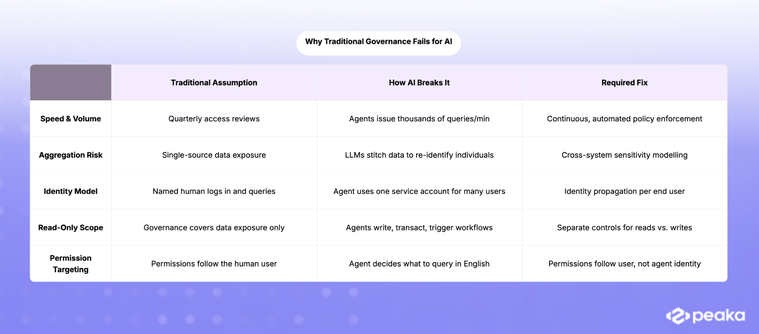
AI consumes data differently, and the control surface has to match.
The control surface of AI data governance
A workable program needs to address all of the following:
Access control at query time
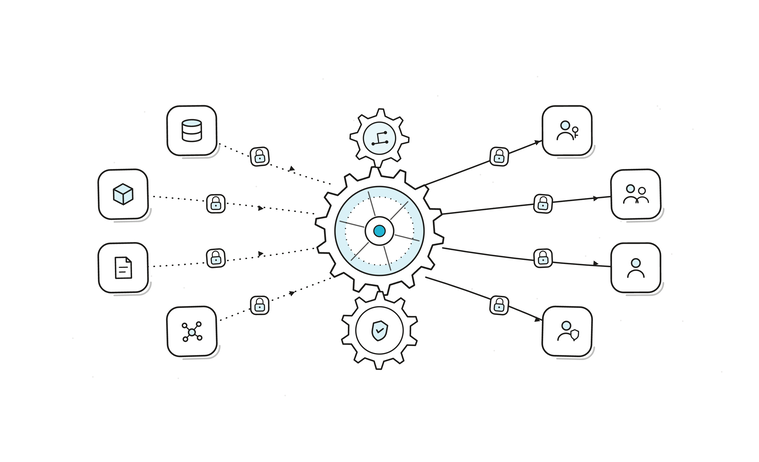
Permissions are evaluated at read time and scoped to the end user the AI is acting on behalf of, not to the service account running the agent.
Data classification
Every dataset is tagged for sensitivity (PII, PHI, financial, internal-only) so policies can apply automatically rather than being hand-wired per integration.
Purpose limitation
The same data may be allowed for one use case (a support copilot) and disallowed for another (a marketing model). Governance enforces the difference.
Output controls
Redaction, masking, and DLP apply to what the AI returns, not just what it queries. An LLM can re-derive PII from non-PII columns.
Auditability
Every AI-driven read and write should be logged with the user, prompt, resolved query, accessed data, and response. The full interaction should be reconstructable after the fact.
Lineage for AI outputs
You need to know which sources contributed to a given AI answer or action, so a wrong output can be traced back to a wrong input.
Action governance
Agents that write, transact, or trigger workflows require stricter, separate controls than agents that only read. The two are different risk classes and should be governed accordingly.
Model and prompt governance
Prompts, system instructions, and model configurations that shape AI behavior should be versioned so that behavior changes are attributable.
Stretching the wrong controls
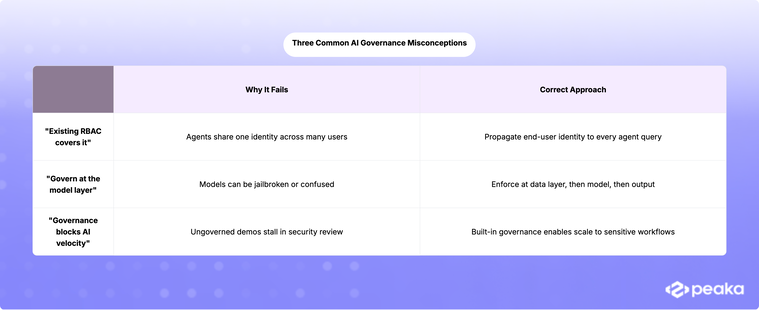
RBAC has been the default for a long time. It was designed for predictable, human-shaped access. Agents act on behalf of many users under a single identity by default, which breaks the model. The solution is identity propagation. The agent queries as the end user, with their permissions, not its own. Agent identities also need to be subject to stricter oversight than human users.
Also, prompt-level guardrails ("don't return SSNs") are necessary but unreliable. Models can be jailbroken, confused, or simply wrong. The more reliable approach is defense-in-depth. Enforce at the data layer first (the AI never sees what it shouldn't), then at the model layer, then at the output layer. Each is a backstop for the others. The instinct to layer these controls is often resisted because teams believe that governance slows AI programs down. The opposite is true in practice.
Teams without governance ship one demo, hit a security review, and stall for six months. Governance designed in from the start lets the AI program scale to more use cases, more data sources, and more sensitive workflows. Ungoverned AI plateaus at low-stakes use cases.
A checklist: Is your AI data governance in place?
One of the most helpful approaches to data governance, in our experience, is to look at it through the lens of a rubric. Use the controls above as a starting point. If you can answer most of the following questions positively (and efficiently), you're likely in a good place:
-
Can you tell, for any AI response, which data sources contributed to it?
-
Are AI queries executed under the end user's permissions, or the agent's service account?
-
Is every AI-driven read and write logged in a way you could hand to an auditor?
-
Are sensitive fields classified consistently across sources or per integration?
-
Are there separate, stricter controls for agents that take actions vs. agents that only read?
-
If a model is swapped or a prompt is changed, is that change versioned and attributable?
-
Can you revoke an AI system's access to a specific dataset in minutes, not weeks?
-
Are output-layer controls (redaction, DLP) in place, or is the model the only line of defense?
A "no" on any of these means you're not yet at gold-standard governance.
Why data virtualization is a solution
You might be wondering why Peaka is writing about this topic. After all, we're a data virtualization product, not a security vendor.
That's exactly the point. Data virtualization (or data federation, as some say) is a natural place to enforce several governance controls at once.
Single query interface
Data virtualization provides one place to enforce access policies across sources. Because everything connects to the virtualization and all queries pass through it, there's no risk of accessing stale data that's been further locked down between sync and query time. Column- and row-level policies apply consistently across heterogeneous systems via federation.
Centralized audit log
Every AI-driven query is captured in one stream. Federation forces everything to be cataloged the same way, making it easy to filter and locate data. Classification metadata is also attached to the layer that the AI actually queries.
That said, virtualization alone doesn't cover output redaction, prompt-layer guardrails, or model versioning. It does make it easy to add those layers by simplifying the data access problem, and it pairs cleanly with an AI security solution.
What is Peaka?
Peaka is a dynamic layer that sits on top of your existing data infrastructure, such as data warehouses, databases, SaaS tools, and operational systems, exposing a single SQL interface with built-in permissions, classification, and audit.
Peaka enforces governance and access at the seam where AI queries meet your data, so agents integrate cleanly without bypassing the systems you already run.
If you’re looking to make your data AI-ready with built-in data governance, book a demo with Peaka.

 Please
fill out this field
Please
fill out this field
 Thank you! You have been subscribed.